


In October 2025, Dr. Genki Terauchi, senior researcher of the Northwest Pacific Region Environmental Cooperation Center (NPEC), host organization of CEARAC, gave a workshop on remote sensing data analysis in Thailand. Then, he participated in the 17th Asia-Oceania Group on Earth Observations (AOGEO) Symposium. The symposium was organized by the Secretariat of the Group of Earth Observation (GEO), the Ministry of Education, Culture, Sports, Science and Technology (MEXT), Japan, and the Geo-Informatics and Space Technology Development Agency (GISTDA), Thailand.
In advance of the symposium, a workshop on “Analysis of Remote Sensing Data for Coastal Ecosystem Studies” was organized at Burapha University on October 13th-14th, and Dr. Terauchi gave a lecture there upon request by Dr. Eko Siswanto, leader of AOGEO Task Group 4 (TG4), and Dr. Anuku Buranapratheprat of the university. In the workshop, he demonstrated the monitoring and assessment of water quality using satellite remote sensing technology and seagrass mapping with optical sensors to the participants including 10 students of the university and local government officials in charge of remote sensing-related tasks in the coastal areas in Thailand.
In the 17th AOGEO Symposium held on October 15th -17th, he gave a presentation, in the TG4 session on Oceans, Coasts, and Islands (OCI), titled “Development of Regional and National Indicator for SDGs 14.1.1a, Index of Coastal Eutrophication, using Ocean Color Data,” and introduced Global Eutrophication Watch (GEW), a tool to assess the eutrophication status globally. The audience asked about the datasets which are currently mounted in GEW and potential of other datasets to be uploaded in the future. TG4 has decided that they will improve the local datasets for Jakarta Bay, Manila Bay and Tokyo Bay.
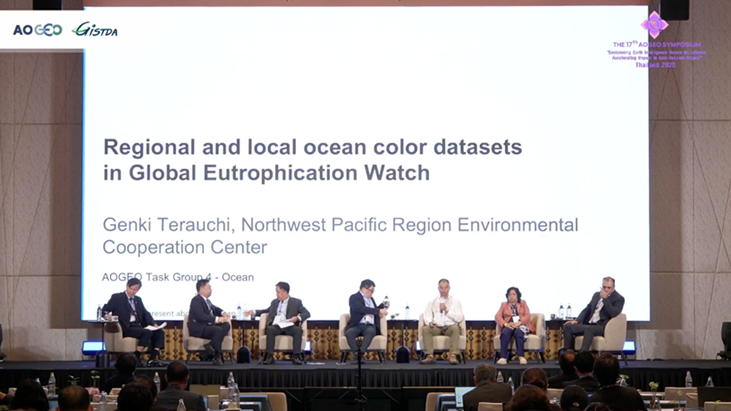
Then, Dr. Terauchi participated, as a panelist, in the Special Session 2, titled ”Earth Intelligence for a Resilient Future: Understanding and Tackling Emerging Threats of Asia-Oceania region.” The term “Earth Intelligence” refers to the knowledge and insights generated by combining Earth observation data (physical quantities) along with various information, such as AI analysis, simulation models, and socioeconomic data. This Intelligence is intended to promote practical actions by central and local governments, businesses and citizens. As a representative of TG4, Dr. Terauchi explained water quality monitoring and its assessment using locally-tuned algorithms, such as ocean color algorithms for the Yellow Sea (YOC) and the Gulf of Thailand, while mentioning GEW. He then shared the idea with other panelists that the approach used in GEW for analysis of big data, which is the combination of Chlorophyll-a concentration and trend, can be applied to other physical quantities. He also pointed out that such ingenuity would be necessary for visualization based on earth observation data. In addition, he emphasized that it was useful to predict future scenarios with models; however, it was more important to understand what was happening at present and its causes.
On the last day of the symposium, the 2025 AOGEO Statement* was adopted, and GEW-related issues were incorporated into the statement as part of future activities (ongoing challenges to be resolved) of TG4: enhancement of local datasets, integration of data from multiple sensors, and linkage with policy-makers.
NPEC has worked to promote the use of GEW during the past few years, and through the workshop and the symposium, this has indeed been obvious in the southeast Asia where monitoring of coastal environments is very active. Now, NPEC plans to improve the GEW website (eutrophicationwatch.org) for its users around the world to be more easily accessible to any locally-tuned datasets in the tool, and at the same time, to advance the development of SDG 14.1.1a: Index of Coastal Eutrophication at national and regional levels based on GEW in the joint research project (EO-RA4**) by the Japan Aerospace Exploration Agency (JAXA).
*URL for PDF file “2025 AOGEO Statement”: https://aogeo17.gistda.or.th/assets/pdf/【Adopted】2025%20AOGEO%20Statement.pdf
**EO-RA4: the fourth Research Announcement on the Earth Observations (EO-RA4)
